
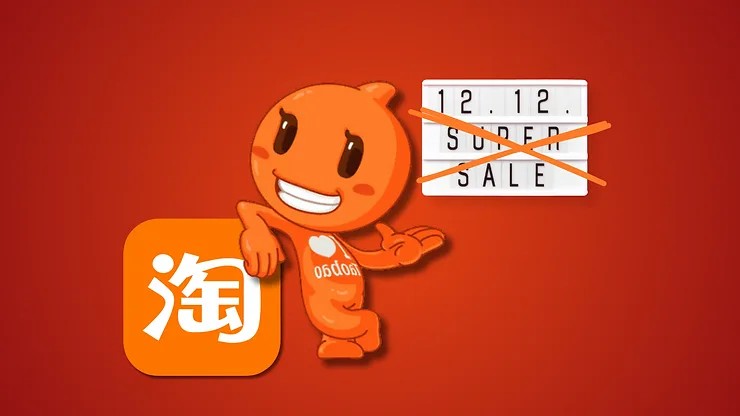
Bad news for Chinese shoppers hoping to pick up a few last-minute presents before the holidays. On the afternoon of 24 November the e-commerce platform Taobao, part of the Alibabagroup, announced the cancellation of a headline event in the year-end sales calendar: the 12.12 shopping festival..
The news stunned consumers, to put it mildly. It quickly became the top trending topic on Weibo, one of China’s main social networks, and clocked up more than 700,000 views in under 24 hours.
But what led the company to change course? Is this a one-off, or a symptom of a shift in the way e-commerce works?
In this article we look at the origins of the event, which first became popular more than ten years ago, and at what may have prompted the Chinese giant to make this last-minute change.
CONTENTS
- 12.12 – The origins of China’s third most popular shopping festival
- Taobao’s U-turn: a sign of crisis or an evolving e-commerce market?
- One, No One and One Hundred Thousand (brands): the importance of standing out
Double 12: the origins of China’s third most popular shopping festival
The Double 12festival, also known as Couples’ Day, was born in China back in 2012 out of a shrewd piece of marketing by the Chinese giant Alibaba. No symbolism or lucky numbers handed down from the ancient traditions of the Land of the Dragon, then: just a purely commercial idea.
The main purpose of the day is (or rather, was… as we now have to say) to help shops clear the surplus stock built up during Singles’ Day (11.11), another hugely popular Chinese shopping festival, and to let sellers, especially smaller ones overshadowed by the big companies, promote their products with time-limited discounts and attract the last customers before the holidays.
Like all promotional festivals, Double 12 drew a large audience from the start, landing not only on Alibaba’s channels but on all of China’s other main e-commerce platforms, such as JD.com and Pinduoduo.
Despite taking in more than 1 million brands and 110 million consumers, 12.12 never came close to the record revenues of Singles’ Day, let alone the dizzying figures of Western shopping events such as Black Friday and Cyber Monday..
So what lies behind the unstoppable decline of an event that had survived for more than ten years? And what can it teach us about the current state of e-commerce?
Taobao’s U-turn: a sign of crisis or an evolving e-commerce market?
Look at the numbers and a reason for cancelling the event is not hard to find. Although Alibaba declined to share its sales results for the second year running, the downward trend of Singles’ Day’s “poor relation” has been plain for all to see for a couple of years.
The reasons for the change of course lie mainly in the ruthless competition between brands, which puts sellers under enormous pressure and often leads to serious failings in customer service: goods never delivered, parcels lost or damaged, and returns that are impossible to handle.
Logistics aside, many have noticed a marked change in consumers’ buying habits since the Covid-19 pandemic, especially in e-commerce. Forced business closures, pressure on household finances, a focus on health and, more generally, a growing awareness of what we consume have led many users to look more closely at the products they buy online and to expect more and more from companies.
The “year-end shopping frenzy” is far from disappearing, in China or anywhere else, but the unstoppable move towards greener and more sustainable thinking has begun to dampen consumers’ interest in the endless run of crazy, unmissable, absurd (take your pick) offers that mark the end of the year, leaving only the strongest standing: Black Friday, Singles’ Day and the like.
So no crisis for Taobao, but a first important signal that every company needs to adapt to the new demands of an increasingly selective and well-informed market. What strategy should you choose, then, to respond effectively to consumers’ needs and make the most of online promotional events?
One, No One and One Hundred Thousand (brands): the importance of standing out
Taobao’s recent change of course gives us plenty to think about.
As mentioned above, online sales have boomed spectacularly in recent years, but at the same time consumers have become ever more careful and selective in choosing products.
In the chaos of the shopping events leading up to Christmas, or Chinese New Year, one thing now seems certain: offering your products at heavily discounted prices is no longer a guarantee of success. The inevitable tendency of so many brands to take a scattergun approach, offering never-to-be-repeated discounts before the holidays, makes it ever harder to be heard among the myriad advertising banners promoting deals.
Broad, untargeted advertising can be a good strategy in the short term, lifting sales straight away, but the risk of investing large sums only to end up fighting for position on page four of the Google results is never far away.
The real key to winning consumers’ hearts is to stand out from the competition, show that you can meet their specific needs and convey the value of your products through marketing strategies designed specifically for your target audience.