
experience, not theory
Lead generation in the
industrial sector
How to go “beyond the catalogue” and find new B2B clients
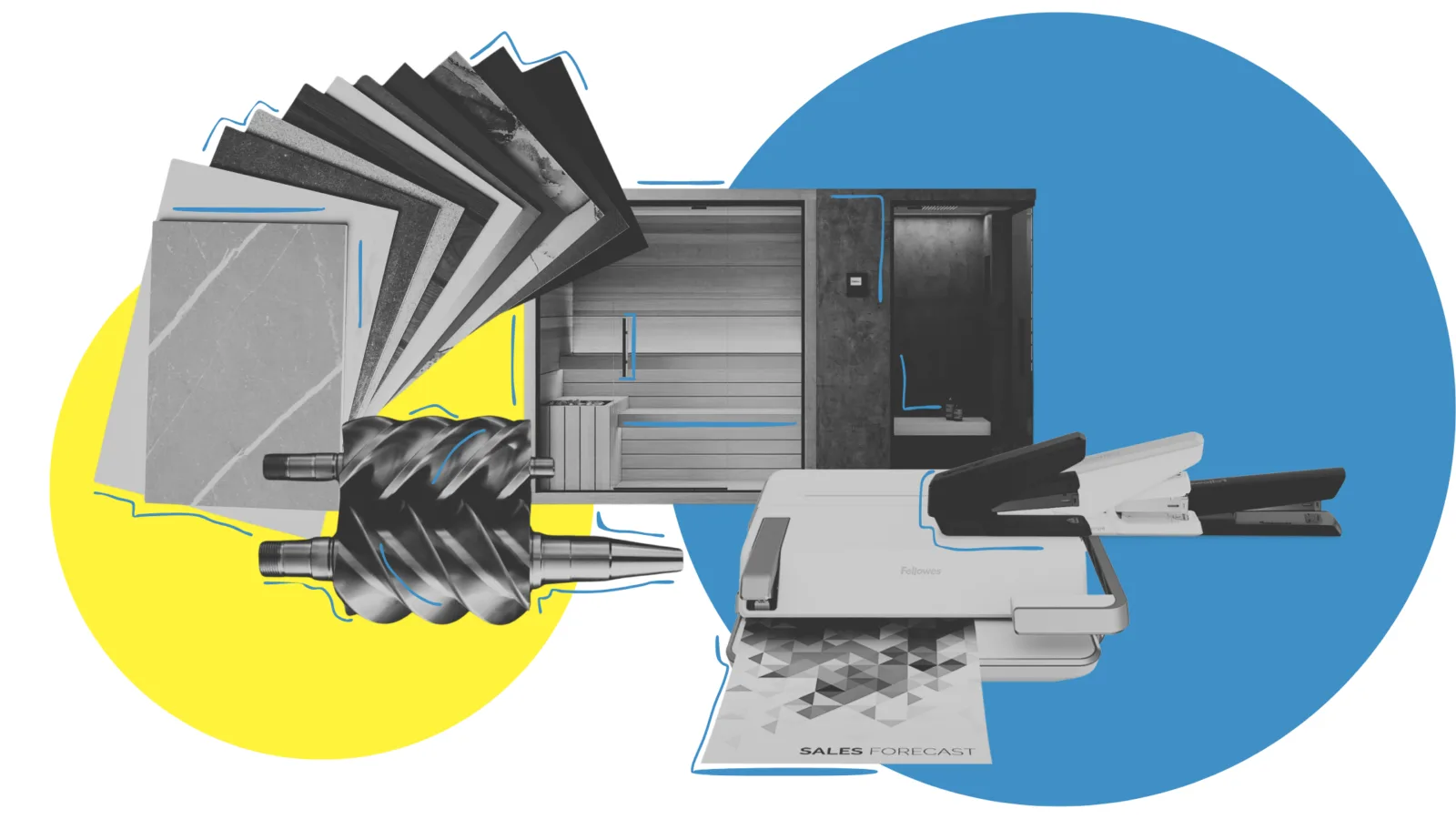
Of all our sector case studies, the one covering the industrial world is the most complex.
That is because the challenge lies less in selling individual products than in selling manufacturing guarantees. Over the years we have worked alongside mechanical engineering and industrial technology companies to turn their technical know-how into an active commercial asset.
In industrial B2B, decisions are more rational and multi-layered than anywhere else. Impulse buying does not exist, and every choice has to go through the engineering department, production and procurement. Perceived risk is extremely high, because choosing the wrong supplier can mean machine downtime or production scrap.
We have analysed our best-performing projects to show you how we broke through the wall of technical scepticism and generated real opportunities in highly conservative markets that resist any change of course.
In this article
you will find:
The specific challenges
of industrial business development
01
Balancing technical detail and value
The risk is swinging between an instruction manual and generic marketing. The challenge is to stay technically precise while explaining what benefit it brings to the business.
02
Speaking to several decision-makers and departments
You need, for example, to reassure the technical departments about feasibility and the purchasing department about costs. Effective communication has to offer different arguments for each decision-making level in the target company.
03
Reducing perceived risk
Every organisation has different needs: some are looking for innovation, others put stability first. Some prefer integrated solutions, while others are interested only in niche products.

How we worked
A structured, flexible and tailored approach
Getting into complex decision-making processes, often tied to budgets already planned, internal gatekeepers and corporate chains of command.
To get into complex decision-making processes, we did not stop at generating contacts: we combined digital positioning, decision-maker profiling and steady, ongoing outreach.
INTELLIGENCE
The strategy began with an accurate map of the technical contacts and decision-makers, because in industry approaching the wrong person means losing months of work. For companies such as Intec and Piùesse, we showed that quality beats quantity: working on short lists, perfectly profiled around production and quality managers, means reaching the people who really know the operational problems.
Identifying the right contact, by cross-referencing research data with each company’s internal dynamics, means starting the conversation with someone who has the authority to assess a new technical partnership.
MESSAGES
Once a foundation of credibility is in place, the crucial step is to start strategic one-to-one conversations that lead to the goal. In the work we did for each client, the message was made to measure for the contact, citing problems specific to their department or dynamics particular to their sector and proposing a discussion about an operational pain point. This approach lets you move beyond standardised sales pitches and present yourself as a potential partner who is competent and aware of the issues facing each prospect company.
and digital
presence
Before any contact is made, the company has to exist, and carry authority, in the eyes of the market. For companies such as Cosmo Tecnology and Intec, we used LinkedIn as a tool for “technical education”. Social selling was used to position the faces of the company as experts who solve problems. Publishing content that explains the reasoning behind a design choice, or shows what goes on behind the scenes in production, lets you “warm up” your target audience.
MANAGEMENT
and FOLLOW-UP
The process ends by taking the relationship offline. Our work with Fellowes showed that a phone call or face-to-face meeting, when prepared by the right digital presence and targeted messages, has a very high conversion rate. At this stage follow-up becomes the secret weapon. With very long decision times, being ready with a call at the right moment, perhaps picking up on an industry event or a piece of content shared earlier, is what turns an expression of interest into a real project.
adaptation
No industrial strategy survives unless it can evolve by listening to feedback from the market. You need the flexibility to change course along the way: if a digital channel proves less responsive, you step up direct contact. Equally, if a technical argument is not landing, you shift the focus to tangible results such as less scrap or more efficient workflows. This constant fine-tuning keeps the communication relevant and competitive, turning clients’ objections into new strengths.
Our clients
one by one
an overview of our projects
Every project, from precision engineering to bespoke systems, has followed one clear thread: an approach that sees industry as an ecosystem of rational, complex decisions. We worked to turn companies’ technical know-how into a language that reassures decision-makers. We focused on the substance of the processes and communicated expertise so that it became a strategic asset for building solid, lasting business relationships.
What all
this means
for B2B
industry
Rather than
one-off results,
these are foundations
to keep
building on.
In B2B industry, the choice of supplier increasingly comes down to reducing perceived risk.
When competitors are easy to compare and offers tend to look alike, companies assess not only the product but, above all, the reliability of the partner.
In this context, marketing and lead generation are not there to create visibility for its own sake, but to build technical credibility. Before negotiations even begin, it is important to show that you understand the real problems of people working in production or on site — scrap, machine downtime, late deliveries — and that you have workable solutions.
In industrial B2B, trust comes from the sense that the supplier can fit into the client’s processes without creating new operational complexity. The method has helped to generate:
The Mallei method has helped to generate:
- Qualified sales opportunities turning lists of names into real negotiations, thanks to profiling that speaks the language of technical decision-makers
- Digital authority which has allowed professionals to become points of reference in their markets, closing the gap with major international buyers
- A stronger brand through an open account of the machinery and processes, making the company tangible and trustworthy even before the first meeting
- Conversion performance above sector averages, showing that a consultative, personalised approach breaks down wariness far better than any aggressive sales pitch
The results
3,4%
average conversion rate.
This is the average conversion rate recorded across the industrial projects analysed, calculated as the ratio between the decision-makers profiled and the real sales opportunities generated.
A particularly significant figure in a market where purchasing decisions are weighed extremely carefully and often held back by the fear of investing in assets that may not guarantee operational continuity or an immediate return. Reaching decision-makers in this setting takes far more than a technical brochure.
More than an isolated result, this number reflects the effectiveness of a method that replaces self-promotion with analysis, turning a plain technical specification into a solid business value proposition.
Our job was precisely to translate process know-how into business relationships built with rigour,, expertise and a language that lowers perceived risk. Even the most advanced innovation needs to be guided to the right person, at the moment they are strategically most receptive.